Thursday, August 12, 2010

Sunboat Suhour

Cairo, Egypt

My CASA cultural guide and fellow RPCV (Morocco), Anita, is leaving Cairo tomorrow. She's one of those enviable uber-extroverts, so naturally she needed a going-away party in a big way, but in Ramadan, you have to get creative with the partying. Anita rose to the challenge with her "Sunboat Suhour."
From Ramadan Kareem fi Musr!
Suhour is the Arabic word for the meal Muslims eat before first light in Ramadan, about 3am local time this year, to fill their stomachs before beginning their daily fast.  Anita invited about 100 of her closest friends to join her on a boat on the Nile to eat and visit all night long, and then hear the call to prayer echo over the water at first light, and watch the sun rise over Cairo.

I didn't bring my camera because I'm not very good at night shots, and I'm so sorry I didn't! One of the most amazing parts of the adventure was walking home at 5:30am. The city was deserted. The only people around were a few police officers, asleep at their posts. It was a vision of Cairo you might never see at any other time!

Wednesday, August 11, 2010

The Problem With RST

(Ramadan Savings Time)

Cairo, Egypt

As I mentioned yesterday, Egypt dropped their clocks back an hour for Ramadan.  So did all my CASA friends and I.  But we didn't think, when we were making our plans to meet before sunset in search of a Iftar tent where we could break fast with real Egyptian Muslims, about how sunset would now be a whole hour earlier.  We planned to meet at 7:00 for a 7:30 sunset ... only to realize at 6:15 that sunset was going to be at 6:30!

So by the time Emma, Cosette and I got on the Metro to meet up with everyone else in Dokki, the call to prayer had already been called.  The Metro was deserted.  The ticket counters were closed while the ticket sellers broke their fast. Just as we were contemplating whether to reach through the glass and exchange our guineas for tickets ourselves, a man emerged to sell us tickets.
From Ramadan Kareem fi Musr!
By the time we actually met up with the girls in Dokki and got ourselves out on the streets in search of an Iftar tent, everyone had finished their meals and closed up their shops for a little cat nap before their midnight snacks.

It was like we were the only people in the city.  You never see Cairo like that.  It was simply amazing, to walk through the streets and not be hassled by men, taxis or shopkeepers.  It was just quiet, in a city that sleeps even less than New York!
From Ramadan Kareem fi Musr!
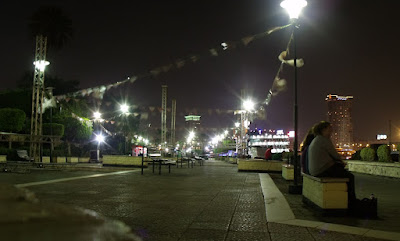
So we went down to al-Gazira Park, which is usually packed with Egyptian couples and families enjoying the Nile-side breeze. Tonight, we had the whole place to ourselves and the quiet sounds of the Nile.
From Ramadan Kareem fi Musr!
In the end, we didn't eat for hours more, but it was a beautiful, extraordinary night!

Tuesday, August 10, 2010

Ramadan Kareem!

In the words of NPR:
Ramadan celebrations are especially famous in Egypt. But this year, the Egyptian government has added a new twist to the holiday by turning back the clock just for Ramadan. That way, people end their fast an hour earlier than they would otherwise, even though the total number of hours they fast will not change.
We had a long conversation about this last night, my CASA friends and I.  Somehow it seems like cheating, to let everyone go home from work an hour earlier than usual, just so they'll have more of their pre-Iftar naptime.  On the other hand, as former CASA student Tim said weeks ago, "When August and Ramadan get together, it's never pretty!"

Ramadan, of course, is the Muslim holy month of fasting, 28 days without food, drink, cigarettes, sex, swearing or arguing (at least in theory) from first light till sunset, followed by all-night feasting with family and friends.  It will be interesting to see how Ramadan is different in Egypt than it is in Jordan.  I have noticed already the Egyptian tradition of Ramadan lanterns, brightly colored glass and chrome hanging lanterns of various shapes and sizes.  Stay tuned for more!

Tonight, we'll be looking for one of those food tents they mention in the same NPR story, so stay tuned to see how that goes!

Monday, August 9, 2010

CASA in the News

Cairo, Egypt

We were interviewed for this article mid- summer, but now it's finally appeared in the Chronicle of Higher Education.

Monday, August 2, 2010

One-Track Minds!

Egypt, Cairo

I've had 3 conversations in Arabic this week, two with taxi drivers, one with the plumber. They all came back to the same topic: sex. Surprise, surprise, I know!

But it's a little (just a little!) more complicated than that. It starts out as a conversation about relationships more generally.

"Is it true that Americans really have boyfriends and girlfriends, just like that?" Cairo is notorious in the Arab world for the growing number of boy-girl relationships you can find here. Find any bridge over the Nile at and after sunset, and you'll find dozens of these couples, holding hands and talking. But it's controversial.

"And your parents know? They don't disapprove?" This is the real sticking point for Cairenes - and Jordanians, for that matter. Despite the rising prevalence of dating, it's almost always done clandestinely. It's okay for men to date, but it's a terrible shame on the family for a girl to be involved in a relationship, however chaste, before marrying. In fact, it can get her killed by family members.

"And American couples ... they have sex?" Because this is the most baffling thing of all about Americans and Europeans dating before marriage. Virginity is still a highly prized commodity in the Arab world, so much so that girls will spend thousands of dollars to have their hymens restored before marriage, just to avoid any hint of shame.

"And what if there's a baby? Whose name will they give it?" Not who will take care of it, but whose name will the baby take. Perhaps one question is a proxy for the other, but it's an indication of the vital importance of family ties, of paternity and acknowledgment in Arab culture.

They're interesting conversations, for sure ... but not conversations I want to keep having with my cab drivers!

Saturday, July 17, 2010

Pre-Finals Fun

Cairo, Egypt

The program director, Dr. Iman, invited us all to her beautiful garden for a delicious dinner. Students from the Music Club performed an Um Kulthum song in Standard Arabic, and another in colloquial Egyptian, and some of the professors also treated us to some amazing performances.
From Dr. Iman's dinner

Coptic Cairo

Cairo, Egypt
From Coptic Cairo
I've written a lot about the Copts in Egypt. Today we visited the neighborhood called Coptic Cairo, starting at the Coptic Museum. Our tour guide, once again, was an AUC Art History professor, who busted a few myths for us about the "primitiveness" of Coptic art. It's her feeling that the proportions are so contrived and stylized in order to differentiate Coptic style from the perfect realism of Greco-Roman styles. This column capital is a perfect example of the blend of stylized proportions and the exquisite craftsmanship of the stonecarvers.
From Coptic Cairo
Then we went around the corner to perhaps the most famous church in Cairo, the so-called Hanging Church because it was built atop one of the towers of the Roman Fortress of Babylon. Long the seat of the Coptic popes, it's been remodeled over and over again, but still retains many of its early architectural and artistic roots.
From Coptic Cairo
Next we went to St. Sergio Church, built over a crypt where Mary, Joseph and the baby Jesus were said to have lived during their exile in Egypt. An Egyptian story goes that the leader of the monastery where they were staying recognized the divinity in Jesus, so when the family was leaving, he hung an ankh around Jesus' neck to protect him, and this is supposedly why the first Coptic crosses were actually ancient Egyptian ankhs.
From Coptic Cairo
Finally, we visited the Ben Ezra Synagogue. Jewish tradition holds that this synagogue is built along the canal (long gone) where Moses was discovered in his basket by the Pharoah's wife. When Jews returned to Fustat centuries later, they discovered certain signs left here by Moses, and built a synagogue in this place. That synagogue was eventually deserted and destroyed, and a church was built in its place, which was later rededicated as a synagogue. It is, however, no longer a working synagogue. Those wishing to go to temple must do so in downtown Cairo.
From Coptic Cairo

Wednesday, July 14, 2010

Birthday Boat Ride

Cairo, Egypt
From Birthday Boat!
I didn't get steak on my birthday (way out of my budget!) but I got the next best thing ... a falucca ride on the Nile with my friends from CASA. Of course, CASA didn't plan this trip because of my birthday, but the timing seemed perfect. Not many better ways to spend a birthday than on a boat, even if it was a "stink-pot," not a sailboat like my last falucca ride. Apparently the low city bridges make a sailing falucca less fun than they look.
From Birthday Boat!
In any case, about half the CASAween went on the trip, which constitutes almost half of everyone I know in Cairo. Cosette and Emma brought baclava to share with the group ... way better than birthday cake! And the captain happened to have Happy Birthday on CD. In fact, we were treated to about 7 versions of it!
From Birthday Boat!
There were water birds, houseboats and crew teams - not a sport I'd ever associated with Cairo before! And just as we rounded the point of Zamalek Island ... my camera batteries died. It seems Ni-MH batteries and heat don't mix well, and I'll have to start storing them in the freezer. Surely there'll be other falucca trips!
From Birthday Boat!

Sunday, July 11, 2010

The First Monastery

St. Paul's Monastery, Eastern Desert, Egypt
From Hurghada and St. Paul
I mentioned before that the Copts of Egypt invented monasticism. Halfway back up the Red Sea Coast, we hung a left into the mountains for a stop at the world's first Christian monastery, St. Paul's. The original monastery didn't have any ground-level doors, to protect it from attacks by marauding Bedouin raiders. Instead, you'd ring a bell and wait for the monks to lower down a basket to lift you up to the top of the wall, or a basket full of food and water to help you on your way.
From Hurghada and St. Paul
The story goes that Paul, son of a rich man, became disillusioned with a life of wealth and exploitation, gave it all up, and went out into the Eastern Desert with only the clothes on his back. He settled in a cave near a spring, fashioned a robe for himself out of palm fibers, and God provided him with half a loaf of bread delivered by a raven every day. We went to his cave and shrine first.
From Hurghada and St. Paul
Tradition also has it that St. Anthony was leading an ascetic life, and was directed in a dream to go to St. Paul in the desert. On that day, the raven delivered a whole loaf of bread for their dinner. But St. Anthony could see that the old man was dying, and St. Paul sent St. Anthony to get the cloak of the bishop for his burial. When St. Anthony returned, St. Paul had died, on his knees in prayer. When St. Anthony, an old man himself, couldn't dig the grave, two lions came out of the desert and dug it for him. St. Anthony buried St. Paul in the bishop's fine cloak, and thereafter wore St. Paul's palm fiber robe on all church holidays. It was St. Anthony who founded the monastery here, and St. Anthony's Monastery at the next closest spring.
From Hurghada and St. Paul
As always, many more details are in the captions of my Web Album.

Saturday, July 10, 2010

Kick Back and Relax!

Hurghada, Red Sea Coast, Egypt
From Hurghada and St. Paul
With my birthday right around the corner, it was time for a trip. There just happened to be one organized by American University's Arabic Language Institute to which CASA Fellows were invited, so I took a little advance on expected birthday income and took a well-subsidized trip to a 5 star resort in Hurghada on the Red Sea Coast.
From Hurghada and St. Paul
Tanned and rested, we came back up through the Eastern Desert along the Red Sea Coast, with its islands and gorgeous aquamarine waters.
From Hurghada and St. Paul

Thursday, July 8, 2010

Talking About Teaching

Cairo, Egypt

This week's topic was education, which made me really happy, since that's the topic I'm best able to talk about in Arabic! And from bottom to top, the problems in the education system in Egypt are exactly the same as Jordan's: enormous class sizes, under-valued teachers, unhealthy focus on all-important exam results, and every parent's insistence that his children will be doctors and engineers, leading to wide-spread cheating in school and beyond. These are the problems everyone can agree on.

Then there are the more controversial problems, controversy aggravated by the role of American politics and money in these issues. There is genuine concern by many - both Arabs and Westerners - about the role education plays in religious extremism. The American solution, backed by American money, is to increase secularization and critical thinking in Arab national curricula, but these are touch topics in a constitutionally Islamic nation like Egypt or Jordan. Islam calls for government to be guided by religious principles, and to direct its citizens on the right path and protect them from sin. That's why, for example, alcohol is illegal in Saudi and proselytizing religions other than Islam is illegal in many Muslim countries. And as for critical thinking, well, that's okay in secular subjects - the sciences and social sciences - but it makes many conservative religious scholars nervous. It smacks of criticism, paternalism, and even neo-imperialism that belittles Egyptian character, values and history.

Meanwhile, of course, Egyptian kids are sitting 60 or 90 kids to a classroom (this is in grade schools!) with underqualified, grossly underpaid teachers who probably wanted to be doctors or engineers, but were forced into teaching because their exam scores weren't quite high enough. And it's just so hard to see a way out!

Wednesday, July 7, 2010

I Wish Mum Could've Come!

Fustat, Egypt


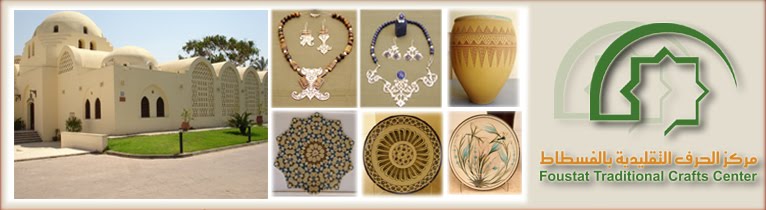
Today the CASA students took a field trip to Fustat, a district on the southern edge of greater Cairo, to the Fustat Traditional Crafts Center. First we visited the pottery workshop, where they showed us every step of the process, from mixing the clay to the right consistency, to some amazing artists on the pottery wheel, to the painting and glazing. It took me right back to the 5th grade, the year that we were homeschooled because of a teacher strike, and spent every Friday morning in a local potter's studio learning all those techniques as well as a 1st, 3rd and 5th grader could.

Then we headed across the street to the rest of the workshops. We started in the mother-of-pearl room, where they were piecing together the iridescent designs on those typical Middle Eastern boxes and backgammon boards.
From Fustat Handicrafts Center
Then we went to the copper workshop, where they were tapping out designs on platters and lampshades using a hammer and chisels or pointers. Next door in the woodshop they were doing carpentry, intricate inlay work, and carving designs in relief:
From Fustat Handicrafts Center
And it turns out that quilting is not only a handicraft native to America, but also native to Egypt. The quilting done at Fustat is all applique, not patchwork, but it's all hand-stitched and gorgeous! They make wall-hangings, seat covers, pillows, and more.
From Fustat Handicrafts Center
Because the Fustat Handicrafts Center's Website is only available in English, I've borrowed a few of their photos and given them English captions in my own Web Album. Enjoy!

Saturday, July 3, 2010

Islamic Cairo

Cairo, Egypt

For excessive detail and superfluous factoids, check out the captions of my Web Album. We saw a ton of historic buildings today, so many that even my enthusiasm for random knowledge began to wane. I'll just hit you with the highlights here:

From Islamic Cairo
Al Azhar
The first famous universities for Islamic law and its related disciplines were in Basra and Kufa in modern-day Iraq, but the oldest university of Islamic sciences currently in operation, and by far the most famous, is Cairo's Al-Azhar University. A degree from here will get you a job in Islamic jurisprudence anywhere in the world. You might call it the Oxford or Cambridge of the Islamic world. Until less than a decade ago, Al-Azhar University was housed in the complex of madrasas, mausoleums, libraries and other related buildings that have accreted around the Al-Azhar Mosque, where we started our tour.

From Islamic Cairo
A Mausoleum Beyond Compare
The Qalawun Complex includes a mausoleum decorated with unbelievably intricate and monumental craftsmanship the likes of which you don't see anywhere in Jordan! There are many mausoleums in Islamic Cairo, especially on the main thoroughfare known as the Street Between 2 Palaces, aka al-Mu'izz Street, referring to two Fatamid palaces whose foundations lie beneath many of the other sites we saw. We saw several mausoleums, but this one just took my breath away!

From Islamic Cairo
Madrasas, Madrasas!
We saw many madrasas on this tour, schools established by endowments of powerful Muslim leaders to teach the principals of one or more of the five schools of Islamic jurisprudence. My favorite was Sultan Barquq's madrasa, which also taught Sufism, the mystic strain of Islam.

From Islamic Cairo
Cairo's Costco (but live-in!)
Merchant wholesalers traveled by caravan across the vast Islamic world, and when they reached a city, they would have to stay somewhere while they sold their wares. Known as a wekala in Arabic, a khan in Turkish, and a caravanserai in Persian, these structures were part market, part hotel, and could even accommodate a successful merchant's "wife in every port." Other caravanserai were positioned near water sources along major trade routes through the deserts, like Qasr Harranah in Jordan.

From Islamic Cairo
Bayt Al-Suhaymi
As much as I love history's monumental structures, I also adore restored homes, giving a more mundane look into history. Unfortunately, a crew was filming some period piece in the Suhaymi House, so we didn't get to enjoy as much of it as I'd have liked. One of many things to go back for!

...And Much More!
There were many other things we saw that you'll find in my Web Album, but this about covers my favorite parts of the morning. (Was it really just a morning?)

Thursday, July 1, 2010

Classes on Copts

Cairo, Egypt

We've been talking about the Copts in Egypt all week, and I've learned that the experience of the Zebballeen I wrote about recently is not necessarily the average Coptic experience. Lest you get the wrong impression of the Copts, I wanted to revisit the topic.

In point of fact, Copts are more likely to inhabit the highest tax brackets. Despite being just 10% of Egypt's population, Copts hold 20% of the country's wealth. Much of it's probably in the church's coffers, which are heavily supported by money from the Coptic Diaspora. Like the Christians of Jordan, Palestine, Iraq and Lebanon, Copts tend to be better educated than a majority of their Muslim neighbors. In those other countries, this is because the British and French gave preference to Christian Arabs in the mandate period. In Egypt, the cause seems to be more like what makes Palestinians in Jordan or Jews in medieval Europe so economically successful. Because Copts have generally had a less than proportionate representation in government in the Islamic period, they've been pushed into the economic sector to support themselves. In any case, it tends to be easier for Copts and other Arab Christians to get visas and lucrative jobs in the West, and they send a lot of money home.

Things were arguably better in the 1920s, when Copts were 20% of the population and held as much as 50% of the country's wealth. Since the revolution that launched the Republic of Egypt, Copts feel that their fortunes are declining. Though there are always a few prominent Copts in government, most of the community feels that they are increasingly marginalized and disenfranchised. One example they cite is that the Egyptian national curriculum requires all Coptic children to learn about Islam, but not vice versa. The history curriculum teaches about the pharaohs and all the Islamic dynasties, but skips the 6 centuries of Coptic history in between.

Coptic Egypt was a vital center of the early Christian world. Monasticism was invented here. The Coptic pope oversaw the First Council of Nicea that developed the Nicene Creed, the description of the basic fundamental beliefs of Christianity that's still in use in the majority of Christian denominations. The strength of the Coptic community has waxed and waned over the centuries, but Copts flourished during the Fatimid dynasty, for example.

And of course there's Boutros Boutros Ghali, my favorite United Nations Secretary General by nature of the fact that his name's just so fun to say!

Sunday, June 27, 2010

Egyptian Fashion

First Impressions

Cairo, Egypt

I've been thinking about this entry since I arrived in Egypt, and after discussing hijab in my MSA class all week, it seemed the perfect time to get it out there.

Now, when I discussed this idea with my new roommate Nellie, who has lived in Cairo for 4 years, she took issue with several of my observations. Bear in mind that they are only first impressions. That said, many of my classmates have lived in Egypt before, and the professor has lived here all his life, and they tended to agree with most of what I'm about to say. My search for good photos also revealed this blogger who agrees with many of my observations, as well as expounding quite beautifully on many more of her own.

This is the photograph in my textbook:

The two women on the left are wearing the chimar, the third woman is wearing the niqab, and the woman on the right is wearing the hijab. In Amman, the hijab is the primary mark of modesty you'll see, and rarely falls much below the shoulders. In rural southern Jordan, you see a lot of niqab, but not so much in the places I've lived. Here in Cairo, the niqab is far more prevalent, and even more so in the villages we passed returning from the North Shore. The chimar is rare in Jordan, but very prevalent here, perhaps especially among middle-aged women and under the niqab. The girls on the right side of this picture are also wearing skirts, which are much more popular here than in Jordan; in this weather, I prefer them, too!

I've also seen a lot more chador here, like the women in the background of this picture:

I generally associate these with Shi'ites, particularly Iraqis and Iranians. Our professor says that they are a very new phenomenon in Egypt, only becoming popular in the last few years. I've seen some very interesting use of the chador, too, incorporating it into a headscarf.

There's also a marked difference in style. In Jordan, most women wear their headscarves not much below the shoulders, if not tucked right into their shirt collars. Here in Egypt, however, fashion seems to favor very long hijab, falling to the waist, hip or even knee:
From Moving to Egypt
There are more images in my Web Album, but you get the picture. It makes me wonder if this style of hijab isn't somehow cooler, and thus more suited to this climate. A style that definitely is cooler is the so-called "Spanish style" that leaves the neck exposed:
From Moving to Egypt
I got this image from The Hijab Blog, an interesting site by a Canadian woman who just adores Cairene hijab fashion.

Another popular trend I've noticed is the layered look:
From Moving to Egypt
This I confess to not understanding at all, as this style must be HOT in Egyptian weather.

In general, I would say that Egyptian girls are more likely to wear hijab than Jordanians, and more likely to wear a more conservative style. This was primarily where my roommate and I disagreed, she claiming that plenty of girls wore "hijab in name only," paired with clothes so tight and revealing that they may as well not bother with the scarf. I've certainly seen those girls here, and there are plenty of them, but not nearly as many as I'm used to seeing in Amman, or even in more rural parts of northern Jordan.

A Note On Terminology
What you will not see in Egypt (nor probably in France, England, or anywhere else that it's generating legal controversy) is the burka, a distinctive and comprehensive covering pretty much exclusive to Afghanistan and parts of Pakistan.
This is not a burka; it's a niqab, but with an extra layer of material covering the eyes:

Tuesday, June 22, 2010

Technology Isn't Always the Answer

Garbage Dreams: The Zebbaleen of Cairo

Cairo, Egypt

My roommate took me to an incredible documentary last night, Garbage Dreams. Not only was it in Egyptian colloquial Arabic so I could pretend it was homework, but it was a poignant, intriguing story.

Until recently, Cairo didn't have a municipal garbage collection service. They had the Zabbaleen. Mostly minority Coptic Christians and all of them very poor, the Zabbaleen saw an economic opportunity, and for generations they've been collecting, sorting, treating and recycling Cairenes' waste. By recycling 80% of what they collect, they are able to earn enough money to live.

Well, they were. And then globalization. Cairo hired foreign companies to collect trash in Africa's biggest city. Now the Zabbaleen face the threat of losing the only way of life they know. Just as bad, those foreign companies only recycle 20% of the waste they collect. An economic and ecological disaster.

The best part of the film is probably when Adham and Nabil go to Wales to see how recycling is done in the "developed" world. While their hostess, who clearly doesn't speak Arabic, shows them with great pride the state-of-the-art facility in Wales, the boys are at times awed by the technology, but mostly aghast at how much recyclable material gets past the machines and ends up in the landfill anyway. Pie in the face of Western liberal green innovation!

If you have a chance to see this film, it's not nearly as grim and grimy as you might expect!

Sunday, June 20, 2010

Not My Cup of Tea

Mersa Matrouh & Alamein, Egypt

I understand that a lot of people get pulled into war on one side or the other for geo-political reasons having very little to do with their personalities. They end up fighting for the "wrong" side because it's the side they identify more strongly with. It doesn't mean that I can feel great sympathy for Hitler's famous Field Marshall Rommel. Yes, he fought a "fair" war against Hitler's explicit orders to, for example, immediately execute all Jewish POWs. I still find it difficult to follow along when the tour guide says that Rommel was a great man.

On our way home from Mersa Matrouh today, we stopped first at the Rommel Museum in Mersa Matrouh itself. The museum has been established in a cave where Rommel had his headquarters for the Battle for Northern Africa, and is filled with personal effects brought to the site by Rommel's son. The first thing you see when you walk in is a big Nazi flag. I guess I spent too many semesters studying 20th Century German history to take that flag as mere historical fact.

Then we stopped at the Commonwealth Cemetery in Alamein, where the WWII dead of the Commonwealth countries and their allies, including Jordanians and Egyptians, were buried. As mind-boggling as the numbers are of dead and missing from the African Front, I found it hard to register any sort of feeling for the place. Then again, maybe it was just the overbearing heat....

Saturday, June 19, 2010

Sandy Beach, Rocky Beach

Mersa Matrouh, Egypt

This evening, we took the bus further west along the coast to see some of the more famous beaches in the area. The Cleopatra Beach, where the last and most famous Queen Cleopatra (the one who married Julius Caesar and Marc Antoni) supposedly bathed, had great rocks. I could've stayed for hours, photographing from different angles.
From Beach Weekend
Then we went a little further along the coast to Agiba Beach, known for its interesting rock formations.
From Beach Weekend

Friday, June 18, 2010

Messing About In Boats

Mersa Matrouh, Egypt

There's nothing more worth doing than messing about in boats!
- Ratty to Mole in The Wind In The Willows

After too much sun and not enough sunscreen on the beautiful white beach in Mersa Matrouh today, the whole ALI/CASA group went down the street to climb onto a pair of boats and see the city from the water.
From Beach Weekend
The bay was beautiful, the water as blue and clear as could be. Out near the line of rocks that protects the bay from the bigger waves of the Mediterranean, we stopped for some swimming and a backflip contest among the military men in the group.
From Beach Weekend
They made great eye candy!

I only wish we'd had an opportunity to sail on some faluka. Just as much as swimming, I love sailing, and it's a treat I haven't been able to indulge in for a very long time!
From Beach Weekend

Tuesday, June 15, 2010

Life As a Taxi Driver

Cairo, Egypt

https://blogger.googleusercontent.com/img/b/R29vZ2xl/AVvXsEg563SyAoQsO7dBlx5OF5RP2IpVdiX_zYP7tc7E3W3e6TTX3lbawMGfD8VzaSCYPp8CMJYJuoSS-0YGk_qw5HlFIvNOqMAUHyqaQXyz0XuQWgPfrv6EnQzFnrt8yWmSKmXgJRQhM60Aads/s400/egypt-jim+and+inge+003.jpg
Today in our colloquial Arabic class we were introduced to Rida', who has worked for 20 years as a taxi driver in Cairo.  We were invited to ask the questions we've always wanted to know the answers to.

Initially he became a taxi driver because when he finished his Associates Degree he had the option to work in an office somewhere, but could make a lot more money driving a cab. This is no longer true, he says; there are now many jobs that make a lot more money than a taxi driver. Still, the money is better than many. Rida' drives a split shift with the owner of the taxi. Rida' drives 6 hours in the morning, and the owner drives 6 hours in the afternoon. He pays the owner a flat fee of LE60 (about $12) per day, plus the cost of the gas (he has to returned the car with a full tank at the end of a shift), and the rest of what he makes is his to keep. Sometimes that's LE50, sometimes it's LE100 or more in a day. Considering that many Egyptians make LE300-400 or less per month, it's not a bad living. Nevertheless, he's pushing his 3 sons to go to university and choose some other profession.

http://greenprophet.com/wp-content/uploads/2009/05/hajj-bus-medina-mecca-photo.jpgRida' has a Class A commercial drivers license, so he can drive anything, and in the afternoons he drives a full size bus. In the past several years, he's also driven buses on Hajj to Mecca and Medina. I can't imagine the stress of that event. As he describes it, everywhere you go on Hajj, as many as 3 million Muslims are going the same way at the same time, by bus or on foot.

But the best question, I think, was when our student teacher Mahmoud said, "I drive in this city for just half an hour and I'm impossibly frustrated, and I don't have to deal with customers who sometimes try to rip me off. How do you keep your cool for 6 hours in this job?"

For Rida', it was a matter of faith.  He recited for us some of the dhikr, or invocations, that he uses to remind himself of the bigger picture. He was quite mellow and philosophical about it. Sometimes, he said, people did pay him far less than the trip was worth, but in his experience it wasn't worth getting upset over, because every customer who cheats him is followed by an overly generous tip, like the man who paid him LE50 for a LE20 ride.

Someone else asked him who were better customers: rich people or poor people? He looked quite embarrassed by his answer, knowing that by Egyptian standards his whole audience were rich people. Unfortunately, he said, rich people were more likely to underpay or fail to tip, and it's the poorer people who are more likely to give tips of 50% or more. He also said that sometimes a customer will stop him and say that they need a ride but have no money, and as long as they ask before they get into the cab, he generally gives them a ride.

There were many other interesting tidbits in the conversation, but I'd call those the highlights.

Saturday, June 12, 2010

Sun Gods and Eternal Waters

The Great Pyramids

Giza, Egypt

I went to the Giza pyramids a year ago, but without a guide and immediately after an exhausting marathon 30 hour trip to Luxor, so I didn't get as much out of the experience as I could have. This time, I went with an art history professor from American University in Cairo, and while we didn't get much time to take artsy photos as I did on the last trip, I learned an awful lot, and saw a lot of things I didn't know were there last time I went.
From Giza by Tour Guide
Ancient Egyptians believed that an individual was composed of three parts: the body, the ka and the ba. The ba was what we conventionally consider the soul, it flies away to the afterworld at death, is often pictured as a bird with a human head, and returns in search of its body after death. The ka, which our guide characterized as the intellect, remains on earth and must be provided with shelter and sustenance (real or, in a pinch, symbolic food and water) after death. The pyramid is shelter for the soul of the pharoah, generally accompanied by smaller pyramids for his wife and important female relatives.
From Giza by Tour Guide
Beyond that are the mustaba, to shelter the ka of the pharoah's important advisers, nobles and hangers on.
From Giza by Tour Guide
Ancient Egyptians also believed that the ba had to cross the Eternal Waters in order to reach heaven. Water and its ebb and flow, of course, were crucial to the success of the great Nile culture, and understanding and navigating those waters was an important skill for an ancient Egyptian. They interpreted the Eternal Waters quite literally, and dug symbolic boat pits beside each pyramid to represent the vessel that would care the ba across those Eternal Waters.
From Giza by Tour Guide
But inside what I took on my last visit to be an incredibly ugly and incongruous monstrosity beside the Great Temple of Kufu turned out to house a treasure I never would have guessed at, an actual boat that was probably once used in service to the Pharoah Kufu himself, was buried with him, and has been reconstructed more or less in situ in the Boat Museum. I won't bore you with the details here, since you can find them in the captions of the photo album.
From Giza by Tour Guide