Showing posts with label Jerash. Show all posts

Wednesday, February 9, 2011

A Breather From Revolution

al-Mshairfeh, Jerash, Jordan

I want to support Egypt, and I've been glued to the TV day after day, but I needed a breather. I don't have the constitution to sit on tenterhooks day and night. And where better to have that break than in my favorite place in Jordan, Wijdan's house! Since I had extended my hospitality (and that of my Jordanian friends) to CASA Fellow Rachel, I extended the village's hospitality as well.
From A Breather From Revolution
I was particularly excited about taking Rachel to Mshairfeh because she's been doing research for her Masters thesis in a small town in Egypt, and I am interested in how she sees them comparatively. We also spent a lot of time on the bus to Jerash comparing the Jordanian Bedouin and Cairene dialects, and I just love people who like to talk linguistics!

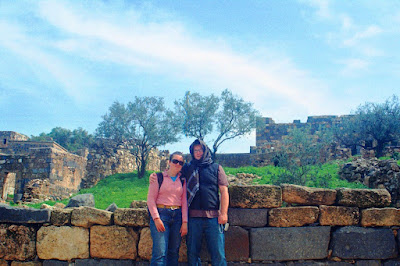
Along the way, we took some time to visit the sites of the Roman ruins at Jerash, of course. It was the first time in a long time that I'd been to Jerash and not had anyone marvel at how I talked like a native. It's true, I really do sound like an Egyptian these days! Rachel even more so, which probably contributed to the confusion.

When we got on the bus to Mshairfeh, with a new bus driver who doesn't know me, there was some confusion as to what "those foreigners" were doing on their bus. "She speaks Arabic," I heard one say, "so ask her!" but no one did. "She used to teach in Mshairfeh," said one older man I recognized from West Msharifeh. Then Wijdan's nephew Sahim got on the bus, whose father owns the bus, and explained, "That's Maryah! She's going to my uncle's house. And she speaks Arabic!" As my pedigree was examined, Rachel and I were listening in and laughing quietly.

When we got to Mshairfeh and Wijdan started asking about where we'd been and what we'd done, Rachel said something I hadn't expected. "Maryah," she said, "is like a completely different person in Jordan. She's so happy all the time, so happy to be here." It's true, but I hadn't known it was obvious.

Watching Rachel play with the little kids reminded me of the early days of Peace Corps, when I really struggled to follow adult conversations at the neighbors' houses, and playing with the little kids was such a welcome distraction. I don't mean to suggest that Rachel's Arabic is bad. In fact, I was impressed at how quickly she was able to make a switch to understanding and even beginning to use Jordanian Bedouin Arabic. But as I said to Tareq when he commented on how much fun Rachel was having with the kids, sometimes it's such a relief to play with little kids that don't speak more Arabic than you do!

Abu Tareq On Egypt
At some point, in our conversations about the protests in Egypt, I said something to Abu Tareq that I expected to be controversial. "When I lived in Jordan," I said, "I thought I was living in a very poor country, but then I went to Egypt and realized that Jordan is not a poor country." I expected Abu Tareq, who sometimes has to borrow from his brother to put food on the table, to think that I was belittling the suffering of poor Jordanians. Instead, without a moment's thought, he agreed wholeheartedly, and started citing statistics of how little money most Egyptians live on. "That's why Egyptians come to Jordan to work for just 5JD a day," he said. "For an Egyptian, Jordan is paradise!" Even as we were hearing on TV that Jordanian hospital doctors were going on strike for 5 hours yesterday, Abu Tareq agreed that Jordan is in no danger of revolution. Jordan is a relatively good place to live, and I think even her worst domestic detractors would agree (off the record, of course!)

Sunday, May 23, 2010

Village Voice, Au Revoir Edition

Mshairfeh, Jerash, Jordan

Sihil's Wedding
The first thing on everyone's mind wherever I went was Wijdan's nephew Sihil's wedding, which starts Wednesday. Village weddings are a 3-day affair, with the henna night on Wednesday, party at the bride and groom's houses on Thursday, and the faarida and a combined party at the groom's house on Friday. I was unofficial photographer and videographer at their engagement, and everyone kept asking if I'd be at the wedding with my camera. Well, everyone but Ghadeer, who has named herself the official photographer. However, only is this my last week of work, but on Friday night, the most important night of the wedding, I'm hosting my going away party. I think only the mother of the groom didn't believe me when I said I wished I could go....

I also got a tour of the newlyweds' house. Every room is a different color, and beautifully decorated. The bedspread was just exquisite. As Wijdan said, "It's as if Sihil's maiden aunts are getting married, and not the boy himself!" They went all-out!

Safa's Engagement
I missed it by just a week! The headmistress's eldest daughter, 2 years out of university, has just gotten engaged to a very handsome young man. They attended the same university, and he's the brother of one of the teachers at the headmistress's school. She showed me their engagement photos. He picked out the engagement gown, which was a gorgeous maroon with a drop waist. She also showed me all the gold he'd provided for her engagement. JD5,000 worth, at the present price of gold. No wonder Jordanian men can't afford to marry!

She'll be married in late July, or after Ramadan in September, depending when their house is ready.

"Mimi"
Taqwa, who will be 2 on my birthday this July, is starting to talk. There's the usual: mama, baba, la! [no!]. She can say "mai" [water], and calls her baba "Habibi" [darling]. "Du?" means "Shu?" [What?] and is one of her favorite words. In retrospect, I suppose I should have been paying more attention, seeing as I've resolved to study Arabic language acquisition as a PhD.... And in the 24 hours I was there, she learned a new word: "Mimi." It's how she referred to me. It reminded me of Claire and Calen's godmother Mimi.

"Take her with you?"
Wijdan confessed to me months back that it was her goal to put as many babies as possible in my arms, so that I would finally decided to settle down, get married and have some of my own. Accordingly, almost as soon as I had arrived at the house, she had Rana deposit baby Milak in my arms. I was glad for the distraction from Wijdan's mother-in-law, who's about as subtle as a razor blade, and doesn't like me much ... probably because I'm friends with Wijdan, and she doesn't like Wijdan at all. So there I was, giggling and "chatting" with Milak, who is playing around with her own vocal repertoire. ("At this rate, she'll be talking before Taqwa!" said Wijdan.) The old woman looked up, incredulous and disdainful as usual. "Do you like girls? Why don't you take her with you. We don't need more girls." It's a common sentiment in Jordan, but it makes me cringe every time!

Quote of the Day
"I'm not going to say goodbye, Maryah. I know you'll be back."
I was expecting a very tearful farewell ... dreading it, actually. Wijdan called me the other night in tears about how she hated her life, and now I was leaving.... But she was surprisingly sanguine about the whole thing, assured that I would return sooner or later.

Wednesday, April 28, 2010

Thistle-stop Tour of Jerash

Jerash, Jordan
From Thistle-stop Tour
I've been to Jerash many times, and every time it's somehow different. Wesley saw Jerash from the top, Mom and Dad photographed it from the bottom up, Auntie Viv photographed it 10 times to Sunday.... This time, it was theaters and thistles.
From Thistle-stop Tour
Wade loves theaters. She studied theater management when we were at Goucher College together, and now she's doing a PhD in history, so historical theaters are a dream come true for her. Jerash has two still standing (three if you count the steps of the Temple of Artemis where concerts were sometimes held during the Jerash Festival), so it was the perfect place to take her.
From Thistle-stop Tour
As for me, I've been to Jerash many times, and am pretty familiar with the big attractions. It gives me more freedom to appreciate the details, like the flowers. We only get about 6 weeks of flowers in northern Jordan, so they have to be appreciated while they're out. In fact, it's because of the lack of color in Jordan for most of the year that I particularly love thistles. After everything else has faded to brown, the flowers of the thistle will still be a bright, cheerful purple.
From Thistle-stop Tour
I stalked a lot of lizards and geckos on this visit, too.

Monday, April 5, 2010

Village Adventures

Mshairfeh, Jerash, Jordan

From Easter Sunday in Mshairfeh
With a 4-day weekend, it was easier than ever to get to Mshairfeh and back again for a quick visit before I trek off to Aqaba. One last breath of fresh air, as it were, before the stifling heat of the Gulf of Aqaba. The weather is always so much more pleasant up in Mshairfeh!

For a short trip, it involved a good deal of excitement.

I Come Bearing Gifts
I always bring Wijdan coffee when I visit, a holdover from my Peace Corps days, and usually cigarettes and a phone card. While I was in tariff-free Aqaba, I bought her a kilo of coffee and a whole carton of cigarettes. I know, I shouldn't be feeding her bad habit, but Wijdan's an adult, and cigarettes are her one indulgence. Besides, you should have seen the look of delight on her face as she was hiding the carton where her husband wouldn't get to it! Just as you should have seen Rana's delight when she came home from school to find coffee on the kitchen counter. No one mentioned the 4 liters of juice I brought for the kids ... but it sure disappeared fast!

Making the Rounds
When I was in Mshairfeh for Sihil's engagement, I got scolded by several of my former neighbors for only visiting Wijdan when I come back to Mshairfeh, so this time I intended to remedy that. (Never mind that I visit Wijdan because she calls every 3 days to find out when I'm coming back, and no one else calls at all....) Then, when I found myself on the bus full of girls I'd taught, including my neighbors Alia and Ayat, the plan solidified.

Around sunset, I went up to Umm Anis's house. They've built a lovely little patio in their garden, with a little fountain and benches on 3 sides. The garden, too, has evolved. It was a sparse bit of land when I left Mshairfeh, but now the bushes and flowers are cheek-by-jowl. It was a lovely place to sit and visit, even if it was still a bit chilly for evenings in the garden.

Then I stopped by Ayat's on the way back, having promised her little brother Ziad (aka My Favorite Jordanian) that I'd be by. Their parents were visiting neighbors returned from 'Umra in Mecca, but Ayat and I had a nice chat about her English studies. Her teacher, obviously a new graduate, is very concerned that they have authentic pronunciation and be able to speak English, something sorely needed here! Then her aunts and uncles stopped by for a visit, all people I remembered and who remembered me. It was a fun time!

She Didn't Even Flinch!
When I got back to Wijdan's, we sat and chatted for awhile, and then headed for the sitting room where her husband Nasri and most of her daughters were already asleep. We hadn't been there more than a couple minutes when Wijdan squealed. Mouse! She plastered herself against the wall in the farthest corner and started shouting to her sons to get rid of it. Then she started shouting at me, "The baby! The baby!" The mouse had disappeared under the mattress where baby Milak was sleeping, and as usual in a pest control situation, I was called on as the most level-headed person in the room. I scooped up the baby.

What ensued was a comedy of pulling up mattresses and beating about with a hand-broom. The boys woke Nasri, who had been fast asleep, and consequently stumbled around the room like a drunkard (Wijdan's description of him, not mine!). After most of the mattresses had been piled up in the center of the room, the mouse decided to make a mad dash for the opposite corner. Everyone else shrieked and scattered, but as the mouse ran right over my foot, all I could think was, If I panic, I'll surely drop the baby, clumsy idiot that I am!

Eventually, we caught the mouse, but as they retold and retold the story the next day, I found myself the hero. "The mouse ran right over her foot, and she didn't even flinch!"

Queen of the Mountain
In the aftermath of the mouse incident the next morning, Ghadeer cleared all the mattresses and pillows out of the sitting room and cleaned. Meanwhile, Taqwa got no end of amusement out of playing Queen of the Mountain atop the pile of mattresses in the salon.
From Easter Sunday in Mshairfeh

Friday, February 19, 2010

Daughter Number Six

Mshairfeh, Jerash, Jordan
From Baby Milak
I went to my friend Wijdan's house in the village for the weekend, because she had a baby (#7) just before my disasterous trip to DC, and I brought back some baby clothes. Now, see if you can follow along: Wijdan's brother-in-law's mother-in-law was visiting for the weekend. Got that? I'd never met her before, so introductions were in order. Wijdan did the honors: "This is Maryah. She used to live in Mshairfeh. She's my sixth daughter!"
Just to be contrary, I asked, "Sixth daughter? Or first?" I am older than all her children, after all....
From Baby Milak
Her new baby's name is Milak. It means angel, but thus far she's proven herself to be somewhat less than angelic. After I'd been there a few hours, Wijdan said to me, "Taqwa was such a quiet baby. She was so easy!" I remember. I met Taqwa when she was less than a month old, too. I couldn't help but wonder if it was because, while Taqwa was a surprise baby, she was a pleasant surprise. Milak, I suspect, is an apology baby, and on an already tight family budget, hard to support.
From Baby Milak
Taqwa was also very unhappy about being usurped as the baby of the family. I've never seen her so withdrawn and uncommunicative, and she was frequently trying to squeeze herself into Mama's lap beside or even underneath the new baby. It reminded me of the line in Berenstein Bears about how Mama's lap was getting smaller and smaller.... It will be fun to watch Taqwa grow into her big sister role.

Friday, January 15, 2010

The Engagement Faarida

Mshairfeh and Asfoura, Jerash, Jordan

I've been sick all week, and I wasn't going to go to Mshairfeh, but when I called to tell Wijdan this, she would hear none of it. "Sihil is getting engaged tomorrow, and you have to bring your camera and come!" I've been to a lot of weddings lately, but it seems I'm always wanted either for my translation skills or my camera....

I always thought the term faarida only referred to the procession to bring the bride on her wedding day, but apparently it also refers to the procession to the bride's village for her engagement party, as well. Nearly half the neighborhood piled into trucks and the father of the groom's bus and chanted our way across northern Jerash.
From Sihil's Engagement
I was hoping to get more still photographs to show you the steps of the engagement party, and to get some nice shots of the people I know best among the groom's family and friends.
From Sihil's Engagement
But Wijdan had other ideas. She wanted video. This was the best of the videos, taken by Wijdan herself.

Friday, November 27, 2009

كل عام وانتم بالف خير

May you and yours be well all year.

Eid al-Adha
Mshairfeh, Jerash, Jordan

This is the most important holiday on the Islamic calendar, when Muslims honor Abraham's willingness to sacrifice his first-born son (Ismail in Islamic tradition) to honor the one true God. Like Abraham, every Muslim household that is able sacrifices a sheep, goat, camel, cow, water buffalo or whatever it is that is husbanded locally. At least once in their lives, every able Muslim should try to go on Hajj and perform this sacrifice on Mount Arafat in Mecca, where Abraham is thought to have done so in Islamic tradition.
From Thanksgiving Weekend in Mshairfeh
It is also traditional to visit family and neighbors, and exchange the traditional blessing: kul 3am wa antum bikhair (May you be well all year). You usually get sweets, too, and the traditional Arab coffee, unsweetened and sharp with cardamom, served in small, bowl-like cups.
From Thanksgiving Weekend in Mshairfeh
It's generally very hot, but as the cups are shared, you must not blow your germs on it to cool it, but rather swirl the coffee in the cup. When you're done, return the cup, and if you don't want another, shake it as you give it back.
From Thanksgiving Weekend in Mshairfeh
Among others, we went to visit Nasri's oldest niece, Suha, to see her newborn son, Asil. Hadeel simply adored the little guy, and couldn't keep her little fingers off his face.
From Tareq Learns to Butcher
When we returned, Nasri was sacrificing one of their goats. Their oldest son Tareq is 17, almost a man himself, and Nasri used the occasion to teach his son how it's done, as Abraham taught Isaac and Ismail. To see it in detail, check out my web album, captioned with explanations.

Thursday, November 26, 2009

Thanksgiving and Politics

Mshairfeh, Jerash, Jordan

Happy Thanksgiving! It happens this year that Eid al-Adha falls the day after Thanksgiving, so I've got a 5-day weekend, Thursday to Monday, just as if I'd never left Pennsylvania!

I'm spending my long weekend with my Jordanian family, dar Nasri, in Mshairfeh, and they have something particular to be thankful for this week. "Did you hear what the king did?" exclaimed Wijdan this evening. I waited for her to be more specific. "He dissolved the Parliament!" I had heard. It's his constitutional right. In the two years I was in Peace Corps, he dismissed the Prime Minister and his cabinet at least three times, though he hasn't interfered much with the government for several years; international aid donors frown on that sort of thing.... Wijdan and her husband, on the other hand, are quite pleased. Nasri explained:
From Thanksgiving Weekend in Mshairfeh
The Parliament is terribly corrupt, he says. All the money they get to help the people and lower prices and unemployment goes instead into the pockets of MPs and their families. They buy themselves nice Mercedes, send their sons to expensive schools and universities, give jobs to their cronies, and the situation never changes for the rest of Jordan. Look at my wife! Ranked first among English teachers in Jerash, and yet she can't get a job! But the king, God bless him, says Nasri, he cares about the people of Jordan. He's looking out for the little guy in his kingdom, and he kicked all those corrupt MPs out of office and called for new elections.

There's no guarantee, of course, that the same MPs won't get their positions back, elected by their extended families and tribes, not for their political platforms or tribes, or for promises of reform, but because they're family. Organizations like NDI are making some progress at teaching Jordanians to run on and vote for issues. Young journalists and activist bloggers tend to understand its importance. Still, those in power are reluctant to let it go, and it portends to be some time before Jordan's democracy looks like, say, Turkey's.

Saturday, October 24, 2009

"ya rait-ni 3andi kombuter!"

["How I wish I had a computer!"]

Mshairfeh, Jerash, Jordan

I'd been at their house less than an hour when Ghadeer said this to me, and it was the perfect opening. I patted the fersha beside me. "Come sit next to me for a minute, Ghadeer." She gave me a funny look. "Just come here! I have a gift for you from my friends in Amman." So she sat down beside me, and I reached into my bag to pull out the second-hand laptop Jad sold me for a steal and handed it to her. I can't even describe how excited she was. In fact, it wasn't long till she'd run out of the room to express her excitement somewhere out of sight. I think perhaps she was running all around the yard getting her parents to come back to the house and see what she'd gotten.
From Laptop Surprise!
It wasn't long until the aunts started showing up with ICDL practice disks. The UN's International Computer Driving License is a pre-requisite for most jobs that village women can get in Jordan. For those of us who grew up with computers, it's ridiculously simplistic, but Mshairfeh has barely had computers for 6 or 7 years, so people need to start with the basics.
From Laptop Surprise!
I'll tell you who's going to be a technology whiz kid, though. I had brought along my laptop, too, and Hadeel wanted to know if I had any games she could play. I discovered that Windows Vista comes with a children's game called Purbles, and she had the game figured out almost as quickly as I did, and without the benefit of being able to read the directions (which were in English). And then, she tried to teach her brother and sister, but they were convinced that they knew better, so instead she resorted to telling them the wrong things and tripping them up at the game.

The same thing happened with my digital camera. She watched me take a few pictures, and just like that, she was off taking pictures of her own, showing them to her sisters and cousins, taking a few more. She even mastered the zoom with only a small hint from me. Her little hands are a bit unsteady, so she cuts off a lot of people's heads, but she's got the general idea!
From Laptop Surprise!
And that, of course, was how the fashion show started. Once the camera was out, the girls were dressing up in every headscarf and new piece of clothing they could get their hands on, begging me to take dozens of pictures. For once, now that I have a digital camera, I could happily oblige and take as many pictures as they wanted, and then download them right to Ghadeer's new laptop.
From Laptop Surprise!
Now, naturally, since I had given their sister a free laptop, the boys had to find something to complain about.
"How come it doesn't have games on it? What good is a laptop to us without games?"
Well, it's not for you, is it? It's for your sister!
"Why doesn't it have sound? It should have sound!"
Just as soon as I can get back to Amman and the Internet and find a driver for it.
"Only 24 giga of hard drive? Come on! The boy up the street's got over 100 giga, and it wasn't that expensive!"
Maybe not, but it wasn't free, was it?
I was a little peeved by all the complaining, but Ghadeer certainly never complained, and I suppose the boys were just jealous!

I have rarely seen a laptop excite such joy. Thank you, Jad, not to mention Carter, Ryan, Rebecca and everyone else in Amman who helped to make it possible.

Thursday, September 3, 2009

Remember Me?

Amman, Jordan

Sometimes you can't predict the people who will remember and recognize you.

I needed a note from the college's doctor to go home early, and I knew the clinic was on Level B1, but I didn't know where, so I asked a security guard. She said, "Are you Maryah?"
"Yes," I said. Since my Peace Corps days, I've become accustomed to being the White Elephant, the person everyone recognizes in a crowd of locals.
"Don't you remember me?"
I get this a lot, too, and while I'm good at recognizing familiar faces, I'm very bad at figuring out why they're familiar. "You look familiar...."
"I'm Kawthar!" she says. "From Mshairfeh."
I take another look, and now I can see it. "Kawthar? How are you? What's new?" Four years ago, she was one of my students in the 10th grade at the girls' school in Mshairfeh where I taught as a Peace Corps Volunteer. "Do you come here every day from Mshairfeh?"
"Ali works here, and I come with him." Clearly I'm supposed to know who Ali is, too, so I smile and nod as if I understand, and change the subject a little. "There are two girls from Bleela [the village down the hill from Mshairfeh] who work at the college and come every morning, too!" She doesn't know them off hand, but maybe she'll figure it out and they can share the carpool burden that much more.
Ultimately, Kawthar can't help me find the clinic, and I really need it, so we part ways, but now I'll be sure to say hello when I can.

It's not a surprise that Ghadeer, Alia, Aaliya and Aiat remember me, or Amal whom I visited to congratulate on her Tawjihi results, or even the girl from my 8th grade class I encountered on the bus the other day. It's not surprising that Hadeel, Ziad, Khaled, FaraH and other little kids from my neighborhood remember me. But if you were to ask me which of my students was most likely to pick me out of a crowd in Amman and introduce herself, it wouldn't be Kawthar!
My 8th graders, May 2005

You see, the Jordanian 10th grade classroom is a very polarized place. By this time in their school careers, students like Alaa and Senabel knew that they would likely pass the Tawjihi and go on to university, and they were a joy to teach, really motivated and diligent. The other half of the class, including poor Kawthar, knew they would fail the Tawjihi, and that their only option in life was going to be to get married and have babies. They weren't going to get the pick of the litter in husbands, either! These girls came to school only because they could spend those hours with their friends instead of scrubbing floors, changing diapers and cooking for their mothers at home. Consequently, they were much more interested in socializing than learning, making them a classroom management nightmare.

It was my first year of teaching, and as a product of the American self-esteem culture, I guess I figured they just hadn't been given much of a chance to see themselves as learners. I had seen how other teachers treated this class, only letting Alaa, Senabel and a few other "smart" girls answer questions, not caring whether the rest of the class was keeping up or not. I used to try to include Kawthar and other troublemakers in classroom exercises. In retrospect, perhaps they thought I was trying to embarrass them, setting them up for ridicule, or trying to make a point about how "stupid" they were. In any case, it never went well, and it didn't help classroom discipline.

I do remember quite clearly how the headmistress lined Kawthar and other 10th graders up in front of the whole school at morning assembly one morning, and had each of them publicly paddled for failing to behave in my classroom. I was appalled, needless to say, and when I walked into their English class a little later, I found those girls, Kawthar chief among them, in furious, mortified tears. They berated me for taking a private matter of classroom discipline in front of the whole school. I'm not sure they believed me when I said that I had not uttered a word to the headmistress about their behavior in weeks (frankly, I'd given up thinking any such thing would make the least bit of difference), but that clearly one of their classmates had decided that the issue of their failure to respect their teacher had to be taken further up the chain of command. (I'm pretty sure it was the headmistress's daughter who tattled.) Ultimately, as I could have easily predicted, this public humiliation did nothing to improve the classroom environment.

Given my history with Kawthar, I would fully expect her to, at best, not admit she knew me, or at worst, to deliberately avoid me. I'm pretty sure I would in her shoes. But maybe, when it came right down to it, I really did make a positive impression on her and some of the other girls I felt were beyond my reach. I hope that's true. It seemed pretty hopeless, as a Peace Corps Volunteer, to make much of any effect on our students' English language within the constraints of the Ministry of Education's curricular requirements. We tried to focus on living as examples of strong, independent, ethical men and women giving back to communities in need. We tried to fan every spark of learning we spotted. I used to tell myself that if I couldn't get every student to pass their English exams, I could at least do my best to convince even the students who struggled the most that they could at least learn something. I hoped that maybe they would pass this on to their own children, and stop the cycle of "Don't ask those students. They're stupid. They can't be taught."

Friday, August 28, 2009

Ramadan, Village-Style

Mshairfeh, Jerash, Jordan

I'd forgotten how much time Jordanians spend cooking! The women, mostly, but even Abu Tareq got involved in filling the qatayef I brought along in response to Wijdan's reply as to what she'd like me to contribute: Bring something sweet like you!

I arrived in Mshairfeh around noon, laden down with juice, dates, cigarettes and the fixings for qatayef. Wijdan is always asking me when I'll be coming back to visit, and I had promised her I'd come during Ramadan, because it just doesn't feel like Ramadan here in Amman, without my Jordanian family to break the fast with. I know, though, that she can barely afford to feed her own children, so I always try to bring something along. Fruit juice because I know they never get anything but Tang. Dates because it's sunna to break your fast with a date. Cigarettes because she always asks for them (though this time I didn't think to bring a lighter, which she also needed). And qatayef because I love to eat one or two, but can't eat a whole batch, and although I know how to make them, I'm not very good at it!I hadn't even been there an hour when everyone gathered in the kitchen. Wijdan was making bread dough to be baked in her new oven later. Abu Tareq and the girls shredded dates, added them to the raisins and coconut I'd brought, folded them into the little pancake qatayef, and pinched the edges closed to make little half-moon pastries.

Then we all napped. There's a lot of napping during Ramadan, especially in these hot, long summer days of fasting. The other common way of passing the time and taking your mind off your stomach is to read Qur'an, but I chose the napping route!

Then, around 4 o'clock, we gathered back in the kitchen and spent the next 3 hours on cooking. Salad, siniiya, kufteh, qatayef, bread, rice.... And all the while watching little Taqwa (18 months) wander around the kitchen and take one bite of every vegetable (even raw potatoes!), bowl and plate, while Ghadeer (18 years) asked every 10 minutes, "Ya Maryah! What time is it?"

That said, there is no better seasoning than hunger, and when we finally tucked into the meal, I tucked away so much delicious food that it hurt for an hour!

Saturday, August 15, 2009

Where the Women Are Strong...

Mshairfeh, Jerash, Jordan

Wijdan: I have to tell you something, Maryah. I'm pregnant again. ... Sometimes I hate myself.

It's sad, because despite circumstances that make lesser women bitter and mean, Wijdan's a great mother. Her eldest daughter, Ghadeer, is one of the brightest students in the village, and Wijdan's doing her best to make sure that Ghadeer gets at least one university degree, even if it means no new Eid clothes for the rest of the family, and that she get it honestly. At the end of last semester, Wijdan went to meet one of Ghadeer's professors. "Did she get good marks? Did she deserve her good marks? Because if I hear that you've given my daughter a mark she didn't deserve, I'll go all the way to the Minister about it!" Her other children may not be particularly apt pupils, but she does her best to insure that they work their very hardest. Kids will be kids and complain about homework and housework and responsibility, but ultimately her children are good people.

That alone can't have been easy, given the influence of their uncle and cousins, who have the respect of almost no one, and are outright despised by many. As my father said when he visited, "I knew that was Wijdan's brother-in-law the moment he appeared, because everyone got stiff and angry. And I do not like that man at all." They didn't even have a common language.

And yet, when Wijdan's eldest son was accused during my visit of giving his female cousin's number to a young man who was making inappropriate phone calls, the family was outraged, and it was righteous outrage. We all know full well that he would no more give out his cousin's number than he would his sister's! He puts on a good facade of rebellious independence, but at his core he's fiercely loyal with strong moral convictions. He is what the Arabs call "ibn al-halaal," a kosher son.

It's easy to see where the children get this from. Wijdan is a one-woman contradiction of Maslow's Hierarchy of Needs, which says that if basic needs are not met, an individual will not be driven to pursue personal growth or societal development. Here's a woman who can barely put food on the table for her 7 children, but dedicates enormous amounts of time and energy to her position as the chair of the village's social welfare society. Not only that, but she's become involved through the local LDS Volunteers in helping other welfare societies in the area. As she was peeling the last of her potatoes for breakfast, she said to me, "If I could, I would take care of everyone. I would make sure that every girl could afford to go to university. I would help everyone."

Quote of the Day:
Abu Tareq: Umm Tareq never teaches me any English!
Hadeel (6 y.o.): What do you want with English? You're a man!

It was the most I'd laughed all week. But it reflects a definite phenomenon in many Jordanian communities, whereby women are pushing their daughters to learn English and get higher degrees because it's their only way out of poverty and misery, but putting far less emphasis on the education of their sons, who have many other options that don't require a university degree.

Friday, August 14, 2009

Strengthening Local Aid Societies

Mshairfeh, Jerash, Jordan

Anyone who knows me well knows that I have very little patience for people who lecture others in order to convert them to any particular religious belief. But anyone who truly knows me knows that I have no objections to people who seek to change hearts through their actions. Jesus preached social transformation by deeds, not words, and I have nothing but admiration for those who embody their love of Christ by doing good works to benefit others. While I regularly turn away the Mormons who come knocking at my door in the States, I have great admiration for the work that LDS volunteers are doing in Jordan.

On one hand, it's about the effect they have had on individual people who are dear to me, namely Wijdan's family and the social welfare society she chairs in Mshairfeh. In addition to the material support they provided for the latter, the previous LDS Volunteers provided tremendous moral and financial aid to Wijdan. In short, the series of LDS Volunteers who have aided Mshairfeh have been good friends to Wijdan and her family. They supported her through a major marital crisis, they've helped her manage the complex politics of chairing a voluntary society, they hired her for occasional translation jobs, and they took her to the hospital and home again when Taqwa was born.

On the other hand, it's the philosophy of development that the current LDS Volunteers were espousing to me at Wijdan's. Their impact has now spread from a dozen societies to over 3 dozen societies in the Irbid and Jerash areas, and in part their philosophy has changed because it's become impractical to serve everyone directly. At the same time, however, it has become possible for societies to help each other, with the LDS Charities merely facilitating, coordinating and helping to provide funds and supplies for the projects in place. The schoolbags they're providing for local children are being sewn and filled by a local society. Another society is assembling hygiene kits. Another is assembling kits for newborns. Another society is teaching villages in the region how to grow and market mushrooms. When a container load of wheelchairs arrives shortly in Jordan, they will be working with Peace Corps Volunteers and local societies like Wes's center in Irbid and Arwen's family's charity Eleanor's Project to distribute the wheelchairs where they're most needed (perhaps in response to the fate of the last load of wheelchairs, which ended up in some local official's private stash). Sustainability is their byword, they said, and I believe it's the only way to go! "Strengthening Families" is their motto, but they're doing more than that; they're strengthening the grass-roots civil society movements that support local families, too.

In fact, it's not just about what they do in Jordan. I remember how impressed I was with what I'd heard about the LDS Charities when I was mucking out houses in New Orleans. It took FEMA, famously, months to get relief supplies into the areas hit by Hurricane Katrina. The LDS Charities, on the other hand, had the essentials packed in container trucks and the drivers on standby 3 days before the hurricane struck, and were on the road as soon as it was clear where they would be needed. Consequently, their supplies were on site precisely when they were needed.

Saturday, April 25, 2009

"Maryah Has Real Arab Friends!"

or, Heba Comes To the Village

or, Everyone Should Learn To Use a Squatter


Mshairfeh, Jerash, Jordan
From Heba In Mshairfeh
We'd been talking about it for weeks, and my work schedule finally obliged. Yesterday morning, Heba and I set out for the village. It had been almost 6 months since my last visit, and people were starting to feel like I'd forgotten them in the big metropolis, and I was starting to lose my connection to the "real" Jordan. Heba just needed, as she put it, a reality check. She's in the weird limbo of many bi-cultural kids: not quite Jordanian, not quite American, and struggling to balance the two. Negotiating a balance between these two cultures is part of what makes Heba and I such great friends.
From Heba In Mshairfeh
Dar Nasri and the other families of Mshairfeh have gotten used to me bringing my very American friend Megan up to the village, to see the real Jordan, beyond Amman and Petra. So of course they took one look at Heba and assumed she was another American. "Maryah! Does she understand Arabic?" And I would turn to Heba - "tifhami 3arabi?" - and let her field the question. In fact, Heba was a joy to take to the village, because there was absolutely no need for me to translate anything, and she always knew the right things to say at the right moment. (Of course, she didn't take belly dancing lessons from the girls, which made Megan an instant hit!)
From Heba In Mshairfeh
It's not unusual for Heba to provoke this reaction, though. Even in Amman, perfect strangers will start to speak to me in Arabic, will look at Heba, and will ask me, "tifham 3arabi?" [Does she understand Arabic?] Even I sometimes forget that she's not an American.
From Heba In Mshairfeh
But the real highlight of the evening for Heba and I was potty training! Despite having lived more than half her life in Jordan, Heba had never used a Turkish or squatter toilet, so when she could no longer hold it any longer, we slipped into the unfinished back room of Wijdan's house, and I taught Heba how to do it. She was so proud of herself, she immediately texted several friends (including my roommates!) to tell them what she'd accomplished. Now we can dress her up and take her out!
From Heba In Mshairfeh
I'm starting to think that everyone should have to use a squatter at least once in their life. At risk of sounding too much like my Marxist roommate, more than half the world's population pees in a hole, and it's not that bad! Especially in Jordan, where you have a nice ceramic base to stand on, and real plumbing out to the septic. As we used to say, "This ain't your mud hut African Peace Corps!"
From Heba In Mshairfeh

Saturday, March 21, 2009

Downsides of an SLR

or, If I Only Had a Digital Camera!
From Philip Goes North
Amman, Jordan

I've been teased a lot in the last few years for still having one of those old-fashioned film cameras, and for most of that time, I've been able to counter that it takes better pictures than some cheap digital camera. That claim's getting harder to make, especially in Jordan. I don't know if it's the way the vendors take care of the film before I purchase it, or the heat I subject it to after I've purchased it and taken pictures, or the quality of the developing, but it seems that all the photos I've taken in Jordan this time around have been grainy and poor quality. They tend to be washed out, too, even with my UV-protected and polarized lenses. I think this is probably because I can't find a place to purchase 400-speed film in Jordan. Every shopkeeper I try to ask says, "The sun is so bright in Jordan, you don't need 400-speed film!" But I think using 200-speed is over-exposing my film. (Not to mention that sometimes I want to take indoor pictures of kids whizzing around, or people dancing, for example.)

The other problem with film cameras is the time it takes to finish a roll of film and develop it. I just developed seven rolls of film this week, the best of which I've uploaded to Picasa. These photos go back months, all the way to our first trip with Tareef Cycling Club: Biking in Wadi Musa and Hiking in Wadi al-Ghwayr. Most of the other pictures are more recent, from the trek down the King's Highway with Philip, John and Ann, from my trip with Philip to Umm Qais and Jerash, and from the day that Ryan, John and I rented a car to go to Ajlun, Pella and Umm Qais. There are still a few more pictures left in my camera, and I'm waiting to get the pictures I took with Philip and Ryan's cameras!
From Ryan's Rental

Thursday, March 5, 2009

Medina-tain of the Decapolis

Jerash and Umm Qais, Jordan

Today we hired a driver and I took Philip north to 2 cities of the Roman Decapolis, the league of 10 cities that were economic and military strongholds on the edge of the Roman Empire in Palestine. I love Petra, and there are so many things there I still haven't done. Still, I find the cities of the north of Jordan more compelling to me. In part, perhaps, it's because I know so much less about them now. Perhaps it's because the mobs of tourists are slightly less. And in the case of Umm Qais, it's definitely the old adage: Location! Location! Location!

From Philip Goes North
Umm Qais

This is my favorite place in Jordan. The view is just amazing: the Yarmouk River Valley, the Syrian Golan, the Israeli Golan, Lake Tiberius (aka Sea of Galilee), the city of Tiberius, Israel, the Jordan River Valley ... you feel like you're standing on top of the world. Add to that the delicious food at the restaurant there, and Philip's fabulous company, and you've got a perfect day! We wandered about in the ruins down the street of columns to the west, too, found the mosaic floor hidden back in the weeds, and some beautiful flowers. This is the best time to visit the northwest of Jordan, because even with the stingy little bit of rain we've gotten this year, the whole Irbid/Ajlun region just explodes with greenery and flowers, like the kind of spring-time I'm used to from the American northeast.

From Philip Goes North
Jerash

Jordanians must have gotten over the little Danish cartoon fiasco, because the Danish-Jordanian archaeology partnership in Jerash seems to be alive and well. Philip and I discovered a number of things that I'm absolutely certain weren't there even as recently as when I came to Jerash with CLS at the end of June. For one, there was this whole Byzantine church next to the Hippodrome and Hadrian's Arch, with this pristine mosaic floor, and I swear it wasn't there before!

Perhaps the most refreshing thing was our timing. We arrived in Jerash in late afternoon, a time at which I'd never visited the Roman ruins there, and I was pleasantly surprised to see a number of Jordanian families lounging in the grass around the park, enjoying the beautiful sunshine and dramatically warmer weather.

From Philip Goes North
Rediscovering Jordan

It's actually been very nice in quite a few ways to be travelling around with Philip (even if people keep mistaking him for my husband!) and doing the tourist thing. Sometimes in Amman, between work and my social life, I almost forget that I'm in Jordan, especially now that my work schedule keeps me from visiting the village. Even cycling with Tareef, while it gets me out of Amman to parts of Jordan I've never seen before, often feels more like California than the Middle East. But with Philip around, I have an excuse to spend a little more money and get out into the country. In fact, our lovely driver Waseem almost has me convinced to sit for the tour guide examinations to become a licensed Jordanian tour guide. I love my job at Bell, but some weeks I feel like I may as well be in Bulgaria or China or anywhere, I use so little Arabic and have so little contact to "real" Jordanian life.

So, please, come visit me in Jordan! Philip, Auntie Viv and my parents will all testify that I'm an excellent trip planner and tour guide, and I only get better with more practice!

Wednesday, January 14, 2009

Are You From Bleela?

Amman, Jordan

Today was our third day of placement testing at Bell Amman. The placement tests themselves have been pretty popular, though the numbers of people who actually enrolled in classes is still disappointingly low. But there are three young women I'm going to come after personally if they don't register for classes!

The first question on the placement test is, "What's your name?" Sometimes the names are vaguely familiar to me, or I can place them as Palestinian or Syrian. The first girl in my 6:00 speaking tests came and sat down with me and told me that her family name was Magableh, and immediately I said, "Magableh? Are you from Bleela?" She gave me a puzzled look. "Yes. How do you know it?" I smiled. "I lived in Mshairfeh for two years. My two favorite teachers were from Bleela and named Magableh." Sure enough, she knew exactly who I meant, and it turns out that this student is a cousin of my Peace Corps counterpart and her sister. So we chatted a bit about this relative of hers and that one. Her English is quite good, almost too good for the classes we're offering on our soft opening. My very next student was also a Magableh from Bleela, a first cousin of the first girl, and it turned out that they went on the same vacation to Aqaba last summer.

(Only much later did I remember that I knew another Magableh from Bleela, Emad, the Mshairfeh English teacher I thought was just my friend, but who didn't have a category for 'female friend' in his worldview. He proposed to me repeatedly for months, and then took a teaching job in Kuwait because "it's too hard to live in the same country as you, Maryah! I'll come back when you leave." He's still in Kuwait, according to my headmistress in Mshairfeh. Now I suppose he'll probably find out that I'm back, and won't be able to come back to Jordan once again.)

Then, right after the Magableh girls, I had a third young woman come in for testing with the surname Mohasneh, which I recognized as being the name of one or more of my colleagues in Mshairfeh, but I wasn't sure from which village. When I asked her the third question, where she was from, I expected to get some clue, but she said Amman. But then, like a good intermediate student, she kept going, saying that she lives in Amman now, but that she came from a small village in Jerash, I'd probably never heard of it. So of course, I had to ask which one! And when she said Kufr Khall, I said, "I worked in Mshairfeh with some teachers from Kufr Khall!" She was less impressed than the Magableh girls, however. (It wasn't until much later that I remembered it was one of my favorite teachers, the teacher of the class for the deaf, who came from Kufr Khall, and I think perhaps one of the Arabic teachers was the Mohasneh I knew.)

It's a small world, isn't it? And if those three young women don't register for classes, I'm going to hunt them down and demand to know why not! (I already cornered two of the students I tested to find out if they were registering or not!)

Tuesday, December 9, 2008

Megan Saves Maryah from Marriage

Mshairfeh, Jerash, Jordan
From Megan and Maryah do Eid al-Adha in Mshairfeh

After all the Eid al-Adha festivities at the homes of Abu Saleh's sons, many of them went to Amman to help Dar Saleh make a sacrifice, as Saleh himself has been tragically incapacitated by a brain tumor. My roommate Megan and I stayed in Mshairfeh and went down the hill to celebrate with Dar Nasri, the family of my best friend and Arabic teacher in the village, Wijdan Umm Tareq. (To better make sense of these names, read this earlier entry.)

Though I have managed to avoid him till now, Wijdan's dirty old man of a brother-in-law Nasr came to visit, along with his second son, Sahem. He started out talking about politics and telling us how the US legal system works, since he's recently begun a law degree at Jerash University (God help us!), and is always eager in any case to make himself look smart. But eventually, as always, he wanted to know why I hadn't married an Arab yet. Before he could recommend his own son as a groom, Megan said, bless her heart, "Maryah! Don't you have a list of requirements for your future husband?"

She was referring to a defense mechanism I had developed in my Peace Corps days to fend off marriage proposals from my colleagues at the Mshairfeh Girls School. I told them that they shouldn't even bother to mention any man to me who didn't meet these 5 minimum requirements, which I began to relate to Nasr, his son Sahem, his wife, and all of Wijdan's family.

1. He must have at least a Masters degree, as I have a Masters degree and don't want him to feel he's less educated than I.
2. He must speak English, not because I don't like to learn new languages, but because it's the global language, and with it we could live anywhere in the world.
3. He must have lived abroad and liked it enough to do so again, because I hope to continue my globetrotting lifestyle for some time.

At this point, Sahem leapt to his feet and stormed out of the house.

4. He must make me his first and last wife.

Now Sahem returned to the house, just in time to hear the last condition, which I didn't always have to mention, but which has never failed to make a Jordanian throw up their hands in disbelief and admit defeat:

5. He must allow his children to choose any religion they choose, by which I don't mean merely Christianity or Islam. My children must be free to choose anything: Hinduism, Taoism, Wicca ... or none at all.

As predicted, they told me that these were absolutely unreasonable requests. Children always follow their father's religion, for a start! It would be absolutely impossible to find someone who met all those requirements!

But of course, this is very good news for me. It will be a very long time, if ever, before anyone asks me again to marry Sahem!
From Megan and Maryah do Eid al-Adha in Mshairfeh

Later, Wijdan wanted to know how I could possibly expect to find someone who would meet my high standards. I pointed out that I had met many men in America who met those requirements, they just weren't the right men, or weren't available. But what about love? she asked. If I fell in love with someone who didn't meet all those requirements, would I still be able to marry them? Of course, I conceded, all of these requirements are ultimately negotiable, but they sure do a great job of fending off marriage proposals in Jordan!

Monday, December 8, 2008

From Sheep To 2nd Breakfast by 10:30am

al-Mshairfeh, Jerash, Jordan

This is the day, Eid al-Adha, that Muslims believe the Prophet Ibrahim (Abraham in English) was supposed to sacrifice his son Ishmael (in Judeo-Christian tradition, it's the other son, Isaac) in Mecca (not Mt. Moriah, as it is in the Old Testament), when an angel intervened and told him to sacrifice a ram instead. In honor of Abraham's extraordinary willingness to obey his Lord, Muslims go on Hajj to Mecca at this time to sacrifice a sheep there, or try to sacrifice one at home as they can afford to. Megan was so fascinated by the stories and pictures of Auntie Viv's Eid al-Adha in the village that she went with me to see for herself. That's her on the right with the big cheerleader smile! So we got up early with Dar Radhi for a fabulous breakfast that included homemade olive oil, home-cured olives, and homemade apple and fig jams, and went out to see the slaughter.
Dar Mohammad and Dar Radhi both sacrificed a sheep apiece. There was great enthusiasm about watching every step of the way. I remember that when Auntie Viv was in the village, everyone was trying to keep the littlest kids, Ziad and Saddeen, away from the sacrifice so they didn't see the sheep die, but not this time. This year, everyone watched every minute of it, except for Megan and I, who got a real ribbing from the Jordanians for not being able to take it.


All of this was watched by Grandpa Abu Saleh with great sanguinity.
Later, when one of his sons asked him why he wasn't helping with the sacrifice, Abu Saleh turned to me and said, "Why should I have to help? I did this for years for these guys! I paid my dues, now it's time for them to do it! Why shouldn't I sit and watch?"

Auntie Viv was much missed in the village this Eid al-Adha, because when she was visiting, we chopped meat with Umm Anis and the other women, but this year Megan just took pictures, and I kept her company, while everyone worked to chop up the sheep...
From Megan and Maryah do Eid al-Adha in Mshairfeh
...deliver bags of meat to all the houses in the neighborhood, and then fry some up for our second breakfast!
From Megan and Maryah do Eid al-Adha in Mshairfeh